Turnkey Solutions
Waste A–Z
Sectors
Project development
Engineering & Delivery
Operations & Lifecycle
Commercial & Investment Models
Warp Gasification
team@univastum.com
Knowledge Base
Chief Technology Officer
Peter Kalenuk
Industrial Waste-to-Steam
Integrated Waste-to-Steam facility for industrial client
Spain
Municipal Waste-to-Electricity
Modular Waste-to-Energy facility for municipal solid waste
Romania
investors@univastum.com
Chief Investment Officer
Eben Klynsmith
Our Approach
Work With Us
Insights & News
Press Kit
mt@univastum.com
Chief Marketing & Communications Officer
Matthew Tucker
About Univastum
Leadership & Governance
Careers
Sustainability
How Does WARP Achieve Low Tar Content in Syngas?
Tar content is one of the key parameters determining syngas quality. If present in excessive quantities, tars can condense as the gas cools, contaminate gas ducts and heat exchangers, and create operational problems for downstream energy equipment.
In WARP, low tar content is achieved primarily within the gasification process itself — through high operating temperatures, reactor architecture and direct extraction of hot syngas from the gasification chamber.
In WARP, low tar content is achieved primarily within the gasification process itself — through high operating temperatures, reactor architecture and direct extraction of hot syngas from the gasification chamber.
What Are Tars and How Are They Formed?
Tars are a complex mixture of condensable organic compounds formed during the thermal decomposition of carbon-containing feedstock.
As prepared feedstock is heated, drying and pyrolysis take place and volatile organic compounds are released. At relatively low and intermediate temperatures, part of these compounds can remain as heavier hydrocarbons.
Primary tar formation is particularly significant at approximately 650–700°C. As temperature increases, cracking and reforming reactions become more intensive and convert heavier compounds into lighter gaseous components.
As prepared feedstock is heated, drying and pyrolysis take place and volatile organic compounds are released. At relatively low and intermediate temperatures, part of these compounds can remain as heavier hydrocarbons.
Primary tar formation is particularly significant at approximately 650–700°C. As temperature increases, cracking and reforming reactions become more intensive and convert heavier compounds into lighter gaseous components.
Why Temperature Matters
Thermal decomposition of heavy hydrocarbons becomes increasingly significant at approximately 800–900°C and above.
At these temperatures, complex organic molecules undergo cracking and reforming reactions, reducing the amount of condensable hydrocarbons remaining in the syngas.
In WARP, hot syngas is extracted from the gasification chamber at approximately 900–1000°C. The high-temperature zone therefore performs two functions: conversion of the prepared feedstock into syngas and further thermal transformation of tar compounds before the gas leaves the reactor.
At these temperatures, complex organic molecules undergo cracking and reforming reactions, reducing the amount of condensable hydrocarbons remaining in the syngas.
In WARP, hot syngas is extracted from the gasification chamber at approximately 900–1000°C. The high-temperature zone therefore performs two functions: conversion of the prepared feedstock into syngas and further thermal transformation of tar compounds before the gas leaves the reactor.
WARP Two-Chamber Architecture
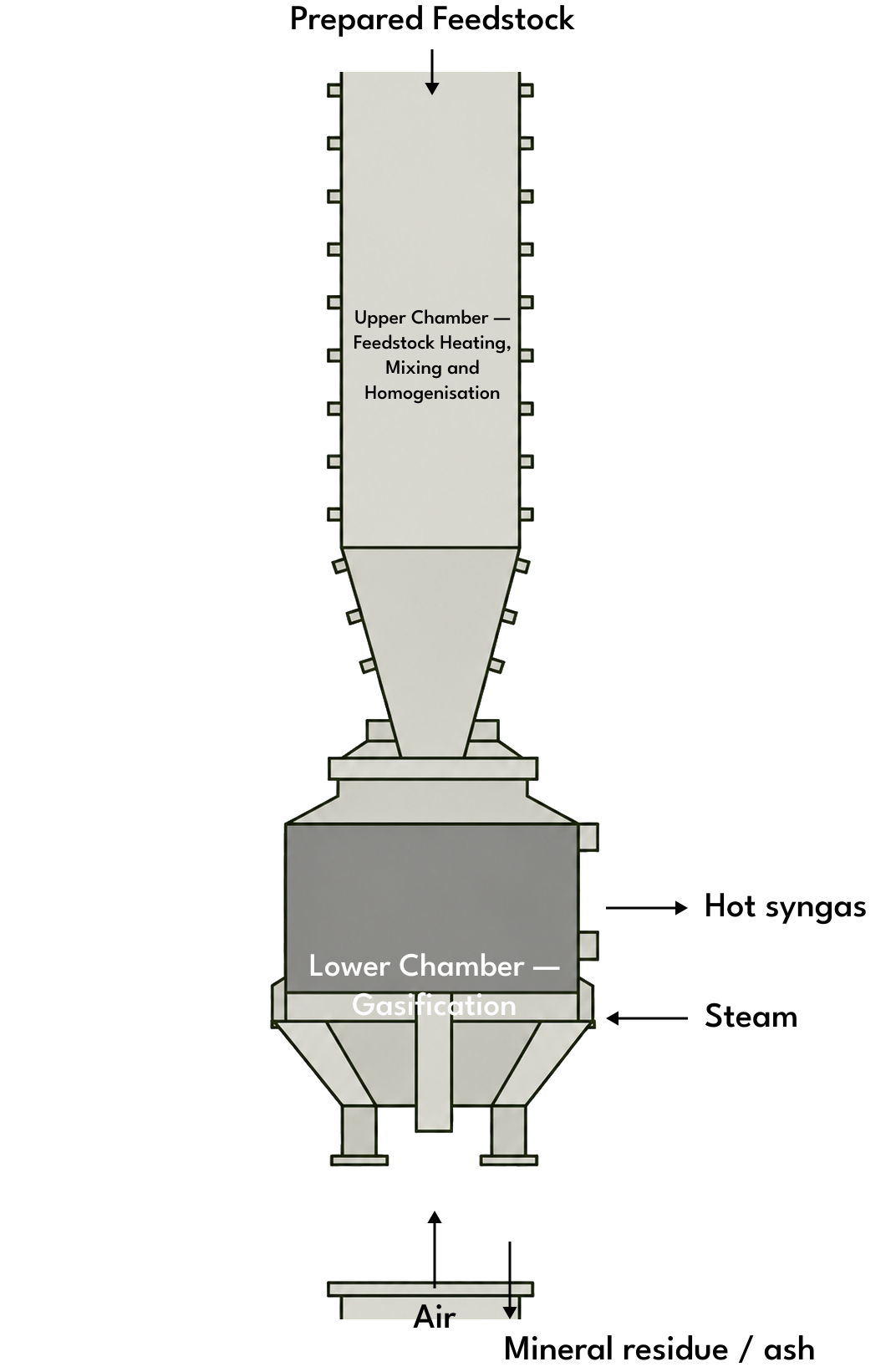
The WARP Reactor-Gasifier consists of two principal chambers.
The Upper Chamber receives the prepared feedstock and provides heating, mixing and homogenisation. The Lower Chamber is the gasification chamber, where the main high-temperature thermochemical reactions take place.
A key feature of the WARP design is that hot syngas is withdrawn from the upper part of the lower gasification chamber.
It does not continue upward through the colder incoming feedstock in the feedstock preparation chamber.
The Upper Chamber receives the prepared feedstock and provides heating, mixing and homogenisation. The Lower Chamber is the gasification chamber, where the main high-temperature thermochemical reactions take place.
A key feature of the WARP design is that hot syngas is withdrawn from the upper part of the lower gasification chamber.
It does not continue upward through the colder incoming feedstock in the feedstock preparation chamber.
Why Syngas Does Not Pass Through Incoming Feedstock
If hot syngas passes through colder fresh feedstock, two processes can occur simultaneously:
hot syngas cools → fresh feedstock is heated → additional pyrolysis products are released → heavier organic compounds can enter the outgoing gas
WARP is designed to avoid this flow path. The geometry of the gasification chamber directs the formed hot syngas toward the extraction point in the upper part of the gasification zone. This allows the gas to retain a high temperature before leaving the reactor and maintains conditions favourable for further thermal conversion of heavy hydrocarbons.
Thermal Cracking of Tars
The WARP approach is not based on producing gas with a high tar load and then removing most of those tars after cooling.
Instead, the objective is to convert as much tar as possible while the gas is still inside the high-temperature reactor environment.
At approximately 800–900°C and above, heavy organic molecules increasingly break down through cracking and reforming reactions into lighter gaseous components, including CO and H₂.
The WARP process sequence can therefore be represented as:
Instead, the objective is to convert as much tar as possible while the gas is still inside the high-temperature reactor environment.
At approximately 800–900°C and above, heavy organic molecules increasingly break down through cracking and reforming reactions into lighter gaseous components, including CO and H₂.
The WARP process sequence can therefore be represented as:
pyrolysis → high-temperature gasification → thermal cracking → syngas extraction at ~900–1000°C → controlled cooling in the Gas Preparation Block
What Happens After the Reactor - Gasifier?
Immediately after leaving the Reactor-Gasifier, hot syngas enters the Gas Preparation Block.
There, the gas is cooled under controlled conditions to approximately 100°C, while part of its thermal energy is recovered for use within the wider Univastum energy system. The gas is then prepared for downstream energy applications.
There, the gas is cooled under controlled conditions to approximately 100°C, while part of its thermal energy is recovered for use within the wider Univastum energy system. The gas is then prepared for downstream energy applications.
The Result
WARP achieves low tar content through four main principles:
The main principle is:
- ~900–1000°C syngas extraction temperature
- Two-chamber reactor architecture
- Direct hot-gas extraction without passing through colder incoming feedstock
- Thermal cracking inside the high-temperature gasification zone
The main principle is:
WARP creates the conditions for tar compounds to be thermally converted before the syngas leaves the gasification chamber, rather than transferring the main tar-removal task to downstream cold-gas treatment.